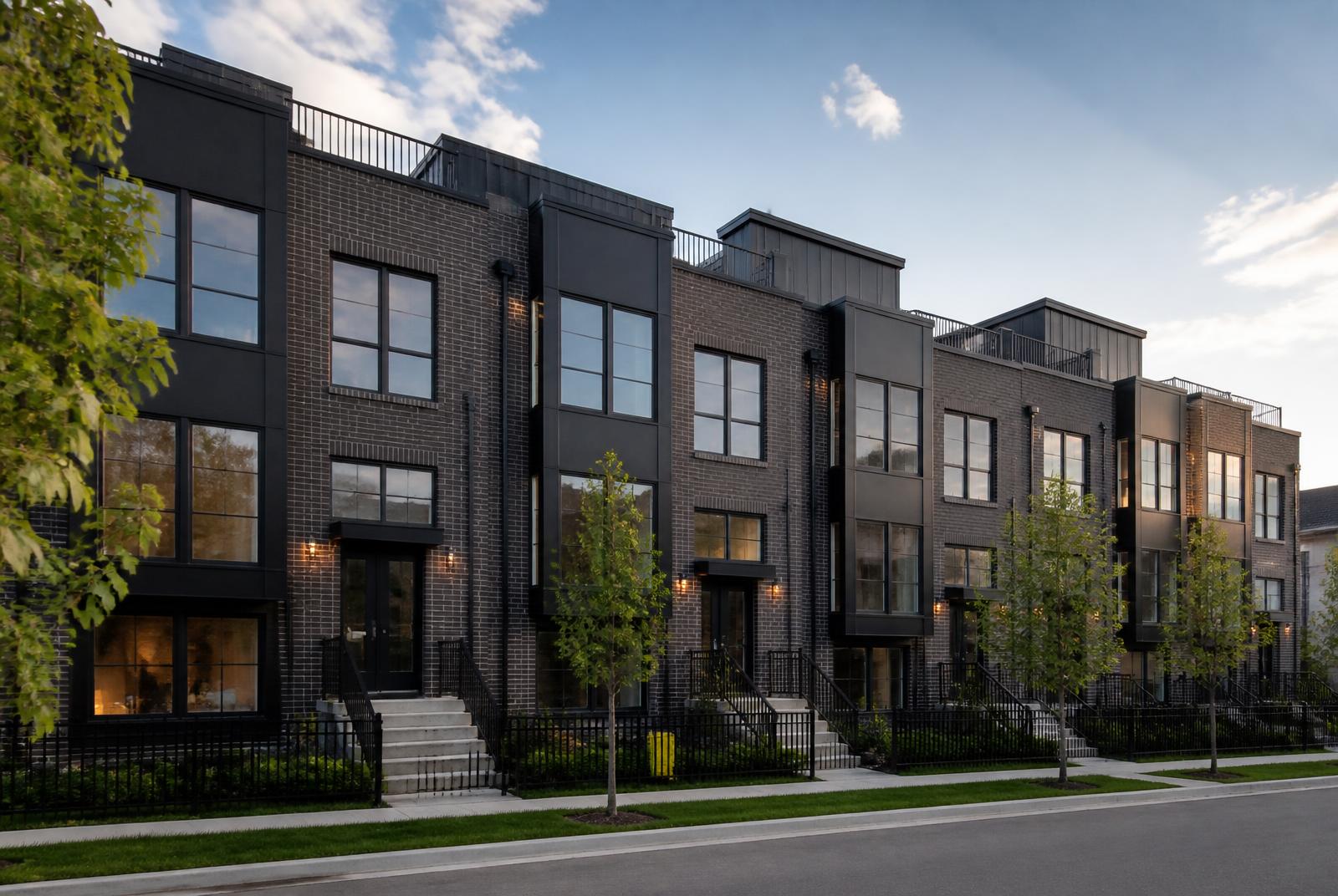
Row of contemporary three-story townhomes with dark brick in South End Charlotte

Townhome Living

South End Townhomes: More Space, Shared Walls

Townhome communities in and around South End offer more square footage and small private outdoor space than most condo product, at the cost of a different HOA structure.

2–3 stories

Typical configuration

Attached, private entry

Common layout type

2000s–present

Primary construction window

Small HOA

Typical association scale

What sets townhomes apart from condos

Townhomes in South End typically offer two to three stories of living space with a private entrance and small attached or nearby outdoor area, distinguishing them from the stacked-unit layout of most condo buildings. This layout appeals to buyers who want more square footage and a greater sense of ownership over their entrance and outdoor space without moving to a fully detached single-family home.

Legally, most South End townhomes are structured as fee-simple ownership of the unit and its lot, sometimes with a smaller homeowners association responsible for shared elements like common landscaping, private streets, or shared amenities, rather than the full-building condominium structure that governs most condo product. This distinction affects financing, since fee-simple townhomes generally avoid the condo warrantability issues discussed elsewhere in South End's condo stock.

That said, some attached townhome-style product in South End is legally structured as condominium ownership rather than fee-simple, so it's worth confirming the actual legal structure of a specific listing rather than assuming based on the physical layout alone.

Where townhome communities concentrate

Townhome communities tend to cluster toward the edges of South End proper and into adjacent areas like Sedgefield, where lot sizes and zoning have historically supported this lower-density-than-tower housing type. These areas trade some of core South End's walkability and transit proximity for more space and a quieter residential feel.

Some newer infill townhome projects have also appeared closer to the neighborhood's core as available land for that density and configuration was developed, though these projects compete more directly with condo product on price given their central location.

Buyers should map out the actual walk time to the nearest Blue Line station or the Rail Trail from a specific townhome community, since this varies meaningfully depending on how close to South End's core edge a given community sits.

HOA and shared-cost considerations

Townhome HOAs generally cover a narrower scope than condo associations — often just common landscaping, private street maintenance, and sometimes a shared amenity like a pool — since owners are typically responsible for their own roof, exterior walls, and structural maintenance under fee-simple ownership. This generally means lower monthly dues than a comparable condo, but it also shifts more maintenance responsibility and cost onto the individual owner.

Buyers should still request the association's budget and reserve study, since even a smaller-scope HOA can face special assessments for private road repaving, retaining wall maintenance, or shared infrastructure repairs. A townhome with attractively low dues but no meaningful reserve fund can still surprise an owner with an assessment.

Insurance requirements differ from condo ownership too — fee-simple townhome owners typically need a more comprehensive homeowner's policy covering the structure itself, rather than the more limited condo-unit policy that assumes the association's master policy covers the building shell.

  • Confirm fee-simple versus condominium legal structure before comparing to other listings
  • Request HOA budget and reserve study even for smaller associations
  • Clarify who's responsible for roof and exterior maintenance
  • Verify insurance requirements differ from condo-unit policies

Parking and outdoor space

Most South End townhomes include a private garage or dedicated parking pad, a meaningful advantage over the shared or unassigned parking arrangements common in some condo buildings. This is frequently a deciding factor for buyers moving from a condo who want the certainty of dedicated, attached parking.

Outdoor space is typically limited to a small patio, balcony, or rooftop terrace rather than a full yard, reflecting the density of the townhome product built in and around South End. Buyers expecting suburban-scale outdoor space should recalibrate expectations, though even a small private outdoor area is a meaningful upgrade over most condo product.

Some communities include shared green space or a community amenity like a pool, which is worth touring in person since marketing photos don't always convey the actual scale and condition of these shared areas.

Financing and resale

Fee-simple townhomes generally avoid the condominium warrantability complications that affect some South End condo buildings, which can make them easier to finance conventionally and can broaden the pool of eligible buyers at resale. This is a genuine structural advantage worth factoring into a buy decision if financing flexibility is a priority.

Resale comparables for townhomes should be drawn from other townhome communities of similar vintage and configuration rather than from condo sales, since the ownership structure, maintenance responsibilities, and buyer pool differ meaningfully between the two categories.

As with any South End purchase, confirm the actual legal and association structure of a specific community with a Canopy Realtor Association member and title company before assuming standard fee-simple financing will apply.

Who townhomes in South End suit

Townhomes tend to suit buyers who want more space than a condo offers — room for a home office, additional bedrooms, or simply more storage — without taking on the full maintenance burden of a detached single-family home. Families and buyers upgrading from a starter condo make up a meaningful share of this buyer pool.

Buyers who prioritize being directly on the Rail Trail or immediately adjacent to South End's dining and brewery core may find condo product better suited to that specific priority, since townhome communities more often sit slightly outside that dense core.

As with all South End housing types, matching the specific community's location, HOA structure, and price point against your actual priorities — rather than a generic sense of what a townhome offers — will produce a better outcome than comparing headline listing prices alone.

At a glance

What matters most here

More space, private entry

Townhomes typically offer two to three stories and a private entrance versus stacked condo units.

Often fee-simple ownership

This generally sidesteps condo warrantability financing issues, though some townhome-style product is condo-structured.

Dedicated parking is common

Private garages or pads are standard, unlike some condo buildings' unassigned parking.

Communities cluster at the edges

Sedgefield-adjacent and peripheral areas host more townhome product than South End's dense core.

Answered

Questions & Answers

Are South End townhomes fee-simple or condo ownership?

It varies by community. Many are fee-simple with a smaller HOA covering shared elements, but some attached townhome-style projects are legally structured as condominiums. Confirm the specific legal structure with the listing agent and title company before comparing financing options.

Source: NC Secretary of State — HOA and business registration search

Do South End townhomes have HOA fees?

Most do, though typically at a lower monthly cost than condo associations since the scope of shared responsibility is usually narrower — common landscaping and private streets rather than a full building structure. Still request the budget and reserve study before buying.

Source: NC Secretary of State — HOA and business registration search

Is parking included with South End townhomes?

Most townhome communities include a private garage or dedicated parking pad, which is a common reason buyers move from a condo to a townhome. Confirm the specific arrangement for a given listing, since it can vary by community.

Source: Mecklenburg County Park & Recreation

How far are townhome communities from the Blue Line?

This varies significantly by community, since townhomes tend to cluster toward South End's edges and into adjacent areas like Sedgefield. Map the actual walk time to the nearest station for a specific listing rather than assuming based on the general South End label.

Source: Charlotte Area Transit System — LYNX Blue Line

Are townhomes easier to finance than condos in South End?

Fee-simple townhomes generally avoid the condominium warrantability rules that can complicate financing for some condo buildings, which can make conventional financing more straightforward. Confirm the legal structure of a specific townhome before assuming this applies.

Source: CEDIA — integrated home technology standards

Do South End townhomes have private outdoor space?

Most include a small patio, balcony, or rooftop terrace rather than a full yard, reflecting the density of the product. Some communities also offer shared green space or amenities, which are worth touring in person.

Source: Charlotte's Got a Lot — official visitor guide

Primary Sources

Figures are compiled from public records and primary sources and are reviewed periodically. Conditions in South End change quickly — verify anything you intend to rely on.