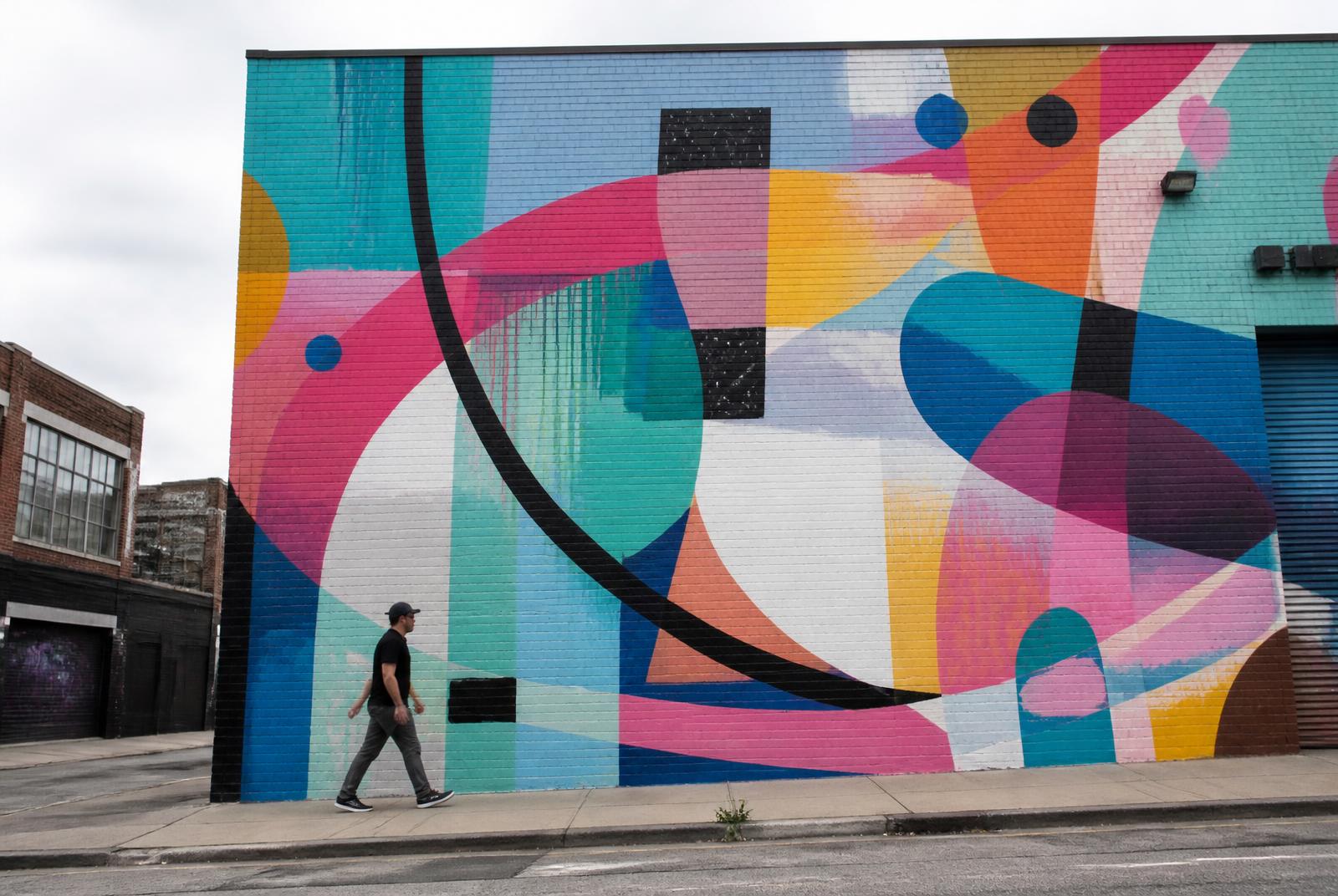
Large abstract mural on a brick warehouse wall in South End Charlotte

Public Art

Murals and Public Art Along the Rail Trail

Public art is one of South End's most visible and least commercial features, turning a stretch of former rail corridor into an evolving outdoor gallery.

Trail-concentrated

Most murals line the Rail Trail corridor

Evolving

Work is added and refreshed over time

Locally driven

Property owners and artists collaborate

Free to view

Public, walkable, no ticket required

Mill-building backdrops

South End's restored mill buildings provide some of the most striking backdrops for public art in the neighborhood, with large brick facades offering scale that newer, glass-heavy construction doesn't replicate as well.

These murals often play off the industrial history of the buildings themselves, and the contrast between old brick and contemporary artwork has become part of the neighborhood's visual signature, frequently appearing in photos of the district.

Because these buildings house active retail and restaurants, the murals also function as backdrops for everyday neighborhood life rather than isolated art pieces, blending into the streetscape.

How the art scene evolves

Unlike a museum collection, South End's public art is not fixed — pieces are added, and occasionally painted over or replaced, as buildings change hands or new projects are commissioned. This gives the scene a living quality but means a favorite mural isn't guaranteed to be permanent.

New development in the neighborhood has, in some cases, incorporated commissioned public art directly into project plans, suggesting the mural scene will keep expanding alongside the district's ongoing construction rather than being confined to older buildings alone.

Because this evolution is decentralized, there isn't a single authoritative map of every piece at any given time, and returning visitors often notice new work has appeared since their last visit.

Beyond murals: sculpture and installations

While murals dominate South End's public art scene, the neighborhood also includes occasional sculptural and installation pieces, often positioned near parks, plazas, or building entrances rather than along the trail itself.

These pieces are generally lower-profile than the large-scale murals but contribute to the same overall sense that the neighborhood treats public space as an opportunity for art rather than purely function.

Some of this work ties into broader Charlotte public art initiatives, connecting South End's scene to a citywide effort rather than existing purely as a local, isolated phenomenon.

Best ways to experience it

Walking or biking the Rail Trail at a relaxed pace, rather than treating it purely as a commuting route, is the most straightforward way to take in the bulk of South End's public art in a single outing.

Weekday mornings or early evenings tend to offer a quieter experience for viewing and photographing the art, since weekend trail traffic can be heavy enough to make lingering in front of any single piece less practical.

Combining an art walk with a stop at one of the neighborhood's coffee shops or breweries along the trail is a natural pairing, since many of the murals are positioned near these businesses rather than in isolated stretches.

Why the art scene matters to the neighborhood's identity

South End's public art plays a real role in distinguishing it from other rapidly developing Charlotte neighborhoods — it signals a district that values character and visual interest alongside new construction, not just density for its own sake.

For residents, the murals become part of the daily backdrop of the neighborhood rather than a special occasion to seek out, reinforcing the sense that South End functions as a lived-in place rather than purely a development project.

For visitors, the art scene gives South End a reason to visit beyond dining and shopping, positioning the Rail Trail itself as a legitimate destination.

At a glance

What matters most here

The Rail Trail is the main gallery

Most of South End's murals and public art concentrate along this single walkable corridor.

Mill facades as canvases

Large brick walls on restored industrial buildings offer some of the most striking mural backdrops.

The scene keeps evolving

New development continues to add commissioned public art alongside older mural work.

Best seen slowly

A relaxed walk or bike ride reveals far more art than a quick pass-through.

Answered

Questions & Answers

Where can you see murals in South End Charlotte?

Most of South End's murals are concentrated along the Charlotte Rail Trail, painted on retaining walls, underpasses, and building facades, with additional pieces on the exterior walls of the district's restored mill buildings.

Source: Charlotte Rail Trail — Charlotte Center City Partners

Is South End's public art scene free to visit?

Yes, the murals and public art along the Rail Trail and throughout the neighborhood are outdoors and freely viewable, requiring no ticket or reservation — just a walk or bike ride through the corridor.

Source: Charlotte Rail Trail — Charlotte Center City Partners

Does South End's mural scene change over time?

It does. Pieces are occasionally repainted or replaced as buildings change hands or new development incorporates commissioned art, so the specific lineup of murals shifts gradually rather than staying fixed indefinitely.

Source: Charlotte Regional Business Alliance

What's the best time to see the art along the Rail Trail?

Weekday mornings or early evenings tend to offer a quieter experience with fewer crowds, making it easier to stop and appreciate individual pieces compared to busier weekend trail traffic.

Source: Charlotte Rail Trail — Charlotte Center City Partners

Is the Rail Trail worth visiting just for the art?

Yes, many visitors treat the trail as a destination specifically for its murals and public art, often combining the walk with a stop at a nearby coffee shop or brewery along the route.

Source: Charlotte Rail Trail — Charlotte Center City Partners

Primary Sources

Figures are compiled from public records and primary sources and are reviewed periodically. Conditions in South End change quickly — verify anything you intend to rely on.